The Stenocara Beetle: The Desert Insect That Inspired Kara Pure 2
Deep in the Namib Desert, a small beetle harvests drinking water directly from thin air—a feat so remarkable it sparked a scientific revolution in water technology. This is the story of how nature’s most efficient water collector became the blueprint for the Kara Pure 2.
What is the Stenocara Beetle (the “Kara Insect”)?
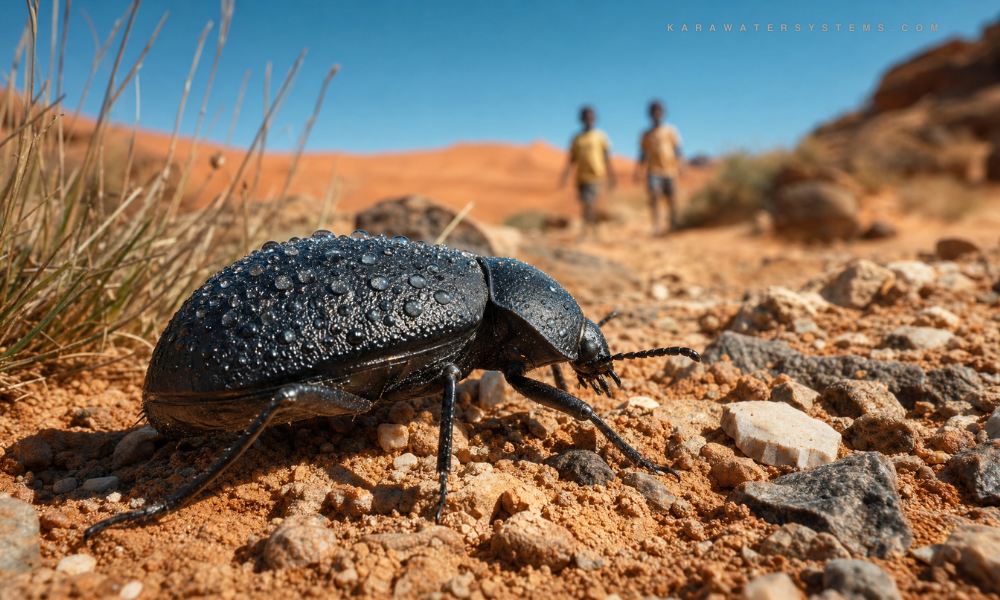
The Stenocara gracilipes—nicknamed the “Kara insect” by Kara Water fans—is a fog-basking beetle native to Namibia’s Namib Desert. It survives in one of Earth’s driest climates by collecting water droplets from morning fog using microscopic hydrophilic bumps and hydrophobic channels on its back. Kara Water’s engineers used this exact biological principle to create the AirDrive™ technology inside the Kara Pure 2.
A Beetle That Defies One of Earth’s Driest Places
The Namib Desert stretches over 55,000 square miles along the Atlantic coast of southern Africa. It receives as little as half an inch of rainfall per year—yet the Stenocara gracilipes beetle thrives here. It has evolved over millions of years to do something extraordinary: extract drinking water directly from the air.
Each morning, a cool Atlantic sea fog rolls inland across the Namib dunes. The Stenocara positions itself on a ridge, tilts its body at a precise 45-degree angle to face the oncoming breeze, and waits. Within minutes, it has collected enough water to sustain itself for the entire day.
“The Stenocara beetle is one of the most efficient water-harvesting organisms ever documented. Its surface architecture achieves collection rates that outperform many engineered systems.”— Reported in Nature, Andrew Parker & Chris Lawrence, 2001

The Science Behind the Beetle’s Water Collection
The beetle’s back is a masterpiece of nano-scale engineering—a surface covered in an alternating pattern of two opposing materials that work together to channel water with stunning efficiency.
Hydrophilic Bumps
Microscopic rounded peaks on the beetle’s back are made of a water-attracting material. Tiny fog droplets—invisible to the naked eye—are pulled toward these bumps and begin to coalesce into larger and larger drops.
Hydrophobic Channels
Between the bumps, waxy troughs actively repel water, preventing droplets from sticking. Once a droplet grows heavy enough, gravity and the hydrophobic channels direct it straight toward the beetle’s mouth—efficiently and without waste.
From Desert Discovery to Global Water Innovation
In 2001, researchers published a landmark study in Nature documenting the Stenocara beetle’s water-collection mechanism in detail for the first time. The findings triggered an international wave of biomimicry research—using nature’s own designs to solve human water challenges.
The key revelation was that the beetle’s efficiency wasn’t about its size, its location, or the density of the fog. It was entirely about the surface architecture—the precise alternation of hydrophilic and hydrophobic zones. That pattern could, in theory, be recreated at any scale.
- MIT engineers confirmed the surface pattern can be replicated synthetically
- The principle works beyond fog—in general atmospheric humidity as well
- Advanced desiccant materials can mimic the beetle’s hydrophilic properties at scale
- Kara Water filed patents applying these biomimetic principles to home water systems
How the Kara Pure 2 Brings the Beetle’s Science Into Your Home
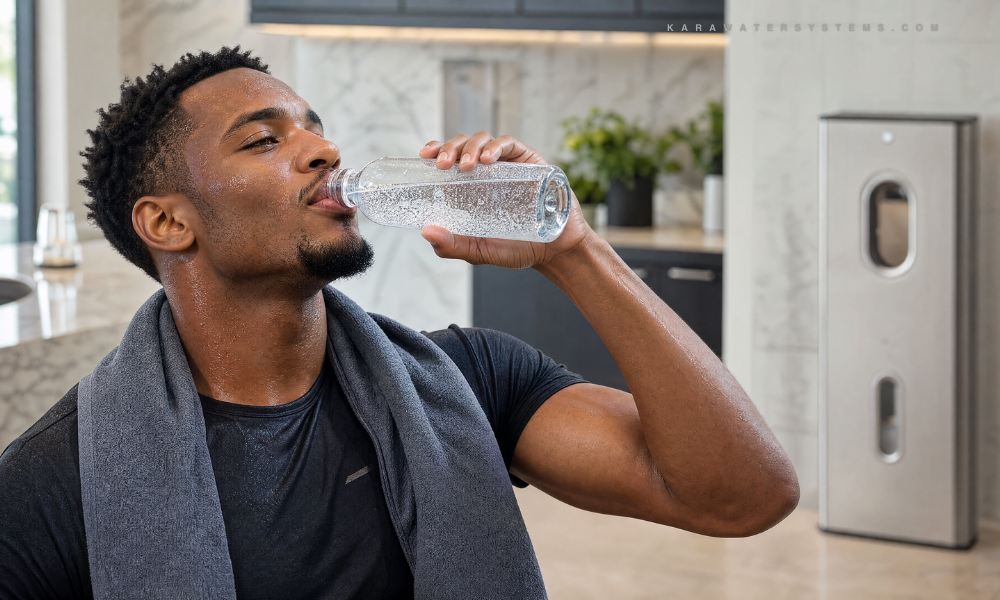
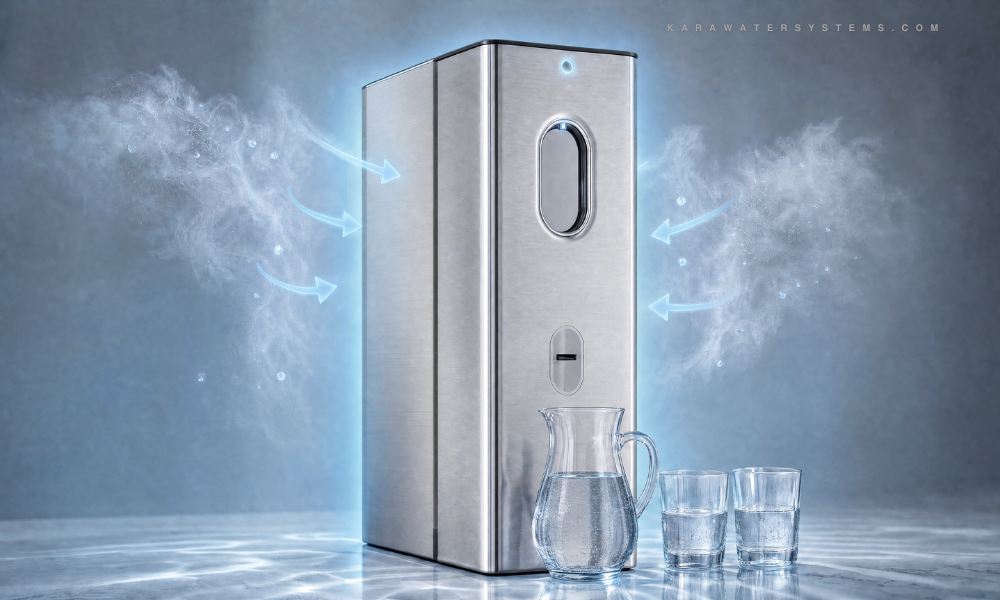
Where the Stenocara tilts into morning fog, the Kara Pure 2 runs 24 hours a day—harvesting moisture from the air around you and turning it into pure, alkaline, mineral-rich drinking water in five precise stages.
Draw Atmospheric Moisture
AirDrive™ desiccant materials—inspired by the beetle’s hydrophilic bumps—attract water molecules directly from ambient air. Works in humidity levels from 30% and above, even in drier climates like Arizona or Texas.
Release & Collect Water
A controlled heating cycle releases the captured moisture from the desiccant material, just as the sun warms the beetle’s back to release collected droplets. The water is collected in a sealed internal reservoir.
Multi-Stage Filtration
The collected water passes through multiple filtration stages that remove any airborne particles, dust, or trace contaminants—producing water far purer than municipal tap water or standard filtered water.
Mineral Enrichment & Alkaline Boost
Six essential minerals are precisely added back, and the water’s pH is raised to a healthful 9.2—delivering water that is not just clean, but actively beneficial for your body’s hydration and mineral balance.
UV Sterilization & Dispense
Before every single pour, UV light neutralizes any remaining bacteria or microorganisms. The result: hospital-grade hydration at your fingertips, at cold, ambient, or warm temperature—on demand.
Zero Infrastructure Required
Unlike reverse osmosis systems that need a water line, or delivery services that need a door, the Kara Pure 2 needs only a standard power outlet. Plug it in and pour—the air around you supplies everything else.
The Stenocara Beetle’s Legacy, in Your Kitchen
The Kara Pure 2 is the consumer realization of decades of biomimicry research. It requires no plumbing, no bottled water deliveries, and no ongoing plastic waste. It simply draws from the most abundant water source on the planet—the atmosphere—and delivers up to 10 liters of alkaline, mineral-rich water every day.
Honored as a TIME Best Invention of 2022 and a CES Award Winner in 2023, the Kara Pure 2 represents the maturation of an idea that started with a tiny beetle on a Namibian sand dune.
Bring the Beetle’s Genius Into Your Home
The same principle that keeps a tiny beetle alive in the world’s oldest desert now powers the most advanced home water system available. Pure. Alkaline. From the air.
Get the Kara Pure 2 →